
How a leader handles pressure, fear, ego, and
understand perfectionism, that’s the difference.
The best leaders understand:- Perfectionism is often fear in disguise.
- Control is often insecurity.
- performance doesn’t transfer from training grounds to stadiums when emotion is unmanaged.
- The difference between healthy and unhealthy fear
- How to create cultures of healthy shame not toxic shame
- High accountability with High emotional and psychological safety
This course gives you those skills.Across 8 modules and 180 questions, you’ll be pushed into a level of self-understanding most people never reach.People crave connection.
But the leader must be the most connected person in the room.
Emotional intelligence is your ability to feel what’s real…understand it, and act with clarity instead of reaction.It’s not being nice. It’s not being calm all the time.
It’s not soft.It’s:
* Seeing your fear without being controlled by it
* Recognising your ego without being blinded by it.
* Knowing your selfishness so you can understand another’s.
* Feeling pressure without overcompensating
* Leading up and down without losing yourself
Most leader don’t lack intelligence.
They lack awareness under pressure.
That’s why:
* Leaders over-control
* Teams disconnect
* Cultures become fragileNot because they don’t know what to do, but because they can’t manage what they feel.
understand perfectionism, that’s the difference.
The best leaders understand:- Perfectionism is often fear in disguise.
- Control is often insecurity.
- performance doesn’t transfer from training grounds to stadiums when emotion is unmanaged.
- The difference between healthy and unhealthy fear
- How to create cultures of healthy shame not toxic shame
- High accountability with High emotional and psychological safety
This course gives you those skills.Across 8 modules and 180 questions, you’ll be pushed into a level of self-understanding most people never reach.People crave connection.
But the leader must be the most connected person in the room.
Emotional intelligence is your ability to feel what’s real…understand it, and act with clarity instead of reaction.It’s not being nice. It’s not being calm all the time.
It’s not soft.It’s:
* Seeing your fear without being controlled by it
* Recognising your ego without being blinded by it.
* Knowing your selfishness so you can understand another’s.
* Feeling pressure without overcompensating
* Leading up and down without losing yourself
Most leader don’t lack intelligence.
They lack awareness under pressure.
That’s why:
* Leaders over-control
* Teams disconnect
* Cultures become fragileNot because they don’t know what to do, but because they can’t manage what they feel.
MODULE 1 - Fear & Control
Understanding fear is vital. I believe fear is as natural as oxygen. It lets us know something important is occurring. This isn’t about eliminating fear. This is about deeply understanding it. And then how to harness it.We try to control outcomes, people, perception because deep down we’re terrified of what happens if we don’t. The missed shot. The failed deal. The rejection. The exposure.
But control tightens you. It chokes instinct. It kills flow.The leaders and performers who rise aren’t fearless they just stop lying about what fear is doing to them. They feel it, name it, and move anyway.
It’s the centre of the VASC methodology I created.
But control tightens you. It chokes instinct. It kills flow.The leaders and performers who rise aren’t fearless they just stop lying about what fear is doing to them. They feel it, name it, and move anyway.
It’s the centre of the VASC methodology I created.
MODULE 2 - EGO
Ego isn’t the enemy. Unseen ego is.
The mind made FALSE sense of self. Ego drives standards. It demands more. It refuses mediocrity.
But left unchecked, it isolates you. Defensiveness creeps in. You stop listening. You protect image over truth.
The work isn’t to remove ego. That’s naïve.
The work is to know it, own it, and lead it rather than letting it lead you.
The mind made FALSE sense of self. Ego drives standards. It demands more. It refuses mediocrity.
But left unchecked, it isolates you. Defensiveness creeps in. You stop listening. You protect image over truth.
The work isn’t to remove ego. That’s naïve.
The work is to know it, own it, and lead it rather than letting it lead you.
MODULE 3 - Vulnerability vs Invincibility
Invincibility is a mask. And it’s heavy.
Vulnerability isn’t weakness it’s exposure to reality.
It’s the moment you admit: I don’t have this figured out.
That’s where growth begins.The best environments in the world aren’t built on pretending.
They’re built on people who can say the hard thing, feel the hard thing, and stay standing.In this module we understand how vulnerability can be used and how it’s the greatest measure of courage.It’s the heart of creating psychological safety BUT whilst keeping a high performance environment.
Vulnerability isn’t weakness it’s exposure to reality.
It’s the moment you admit: I don’t have this figured out.
That’s where growth begins.The best environments in the world aren’t built on pretending.
They’re built on people who can say the hard thing, feel the hard thing, and stay standing.In this module we understand how vulnerability can be used and how it’s the greatest measure of courage.It’s the heart of creating psychological safety BUT whilst keeping a high performance environment.
MODULE 4 - Cultures of Healthy Shame vs Toxic Shame
Shame is misunderstood.
Toxic shame says: You are the problem.
It shrinks people. Silences them. Breaks identity.Healthy shame says: That wasn’t good enough.
It calls you up, not out. It holds a standard without destroying the person.Great cultures get this balance right.
They challenge behaviour without attacking worth.
Toxic shame says: You are the problem.
It shrinks people. Silences them. Breaks identity.Healthy shame says: That wasn’t good enough.
It calls you up, not out. It holds a standard without destroying the person.Great cultures get this balance right.
They challenge behaviour without attacking worth.
MODULE 5 - TRUST & BELIEF
Shame is misunderstood.
Toxic shame says: You are the problem.
It shrinks people. Silences them. Breaks identity.Healthy shame says: That wasn’t good enough.
It calls you up, not out. It holds a standard without destroying the person.Great cultures get this balance right.
They challenge behaviour without attacking worth.
Toxic shame says: You are the problem.
It shrinks people. Silences them. Breaks identity.Healthy shame says: That wasn’t good enough.
It calls you up, not out. It holds a standard without destroying the person.Great cultures get this balance right.
They challenge behaviour without attacking worth.
MODULE 6 - AUTHENTICITY
Authenticity isn’t “being nice.” It’s being real.
It’s knowing who you are and not adjusting it for approval.That comes at a cost.
People won’t always like you. Some will resist you. Others will test you.
But the ones who matter? They’ll trust you.
Because real recognises real.In this module we learn about why authenticity matters and how it’s applied
It’s knowing who you are and not adjusting it for approval.That comes at a cost.
People won’t always like you. Some will resist you. Others will test you.
But the ones who matter? They’ll trust you.
Because real recognises real.In this module we learn about why authenticity matters and how it’s applied
MODULE 7 - EMPATHY
Empathy is strength, not softness.
It’s the ability to step into someone else’s world without losing your own.To feel what they feel but still lead.
Without empathy, you get distance. Disconnection.
With it, you get loyalty. Effort. Trust that goes beyond instruction.Empathy in high-performance environments is different from empathy in day-to-day life.Empathy from the Greek em pathos : in feeling.
It’s about our leaders, staying connected to our feelings now and in the past in order to connect with others. Applied with wisdom it’s a game changer.
It’s the ability to step into someone else’s world without losing your own.To feel what they feel but still lead.
Without empathy, you get distance. Disconnection.
With it, you get loyalty. Effort. Trust that goes beyond instruction.Empathy in high-performance environments is different from empathy in day-to-day life.Empathy from the Greek em pathos : in feeling.
It’s about our leaders, staying connected to our feelings now and in the past in order to connect with others. Applied with wisdom it’s a game changer.
MODULE 8 - SWEAT & COURAGE
This is where it all lands.No theory survives without action.
Sweat is the work. The repetition. The unseen grind.
Courage is the decision to go again when everything in you wants to stop.In this final module, we learned the heart of the VASC methodology.
That all we truly have is the ability to give all of us ourselves physically and have the courage to be authentic. We move this from words on the wall, to the application in high-performance environments
ENQUIRE ABOUT ORGANISATIONAL DELIVERY >>>Sweat is the work. The repetition. The unseen grind.
Courage is the decision to go again when everything in you wants to stop.In this final module, we learned the heart of the VASC methodology.
That all we truly have is the ability to give all of us ourselves physically and have the courage to be authentic. We move this from words on the wall, to the application in high-performance environments

BRING THIS IN TO YOUR ORGANISATION
Advanced Emotional Intelligence For Elite Environments
This course is not delivered publicly in large open groups.
It is integrated directly into leadership environments where performance, pressure, identity, culture and emotional resilience matter.
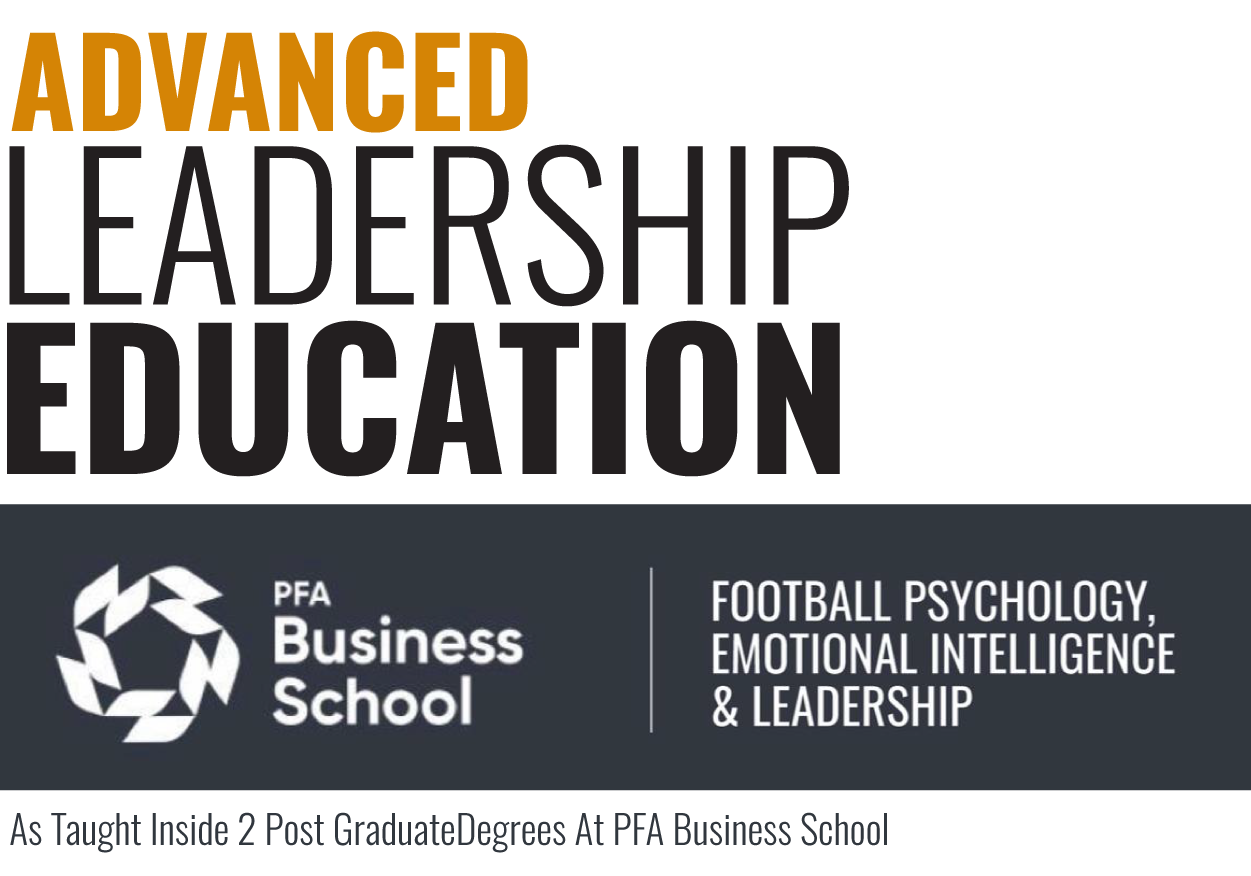
The methodology has been taught inside postgraduate leadership education at the Professional Footballers’ Association Business School and is now being explored across elite sport, leadership and performance environments.
Designed For:
* Football Associations
* Professional Clubs
* Coach Education Pathways
* Leadership Teams
* Universities
* High-Performance Organisations
Advanced Emotional Intelligence For Elite Environments
This course is not delivered publicly in large open groups.
It is integrated directly into leadership environments where performance, pressure, identity, culture and emotional resilience matter.
The methodology has been taught inside postgraduate leadership education at the Professional Footballers’ Association Business School and is now being explored across elite sport, leadership and performance environments.
Designed For:
* Football Associations
* Professional Clubs
* Coach Education Pathways
* Leadership Teams
* Universities
* High-Performance Organisations
DELIVERY OPTIONS
- Embedded Organisation Partnership
- Integrated leadership education delivered inside your environment.
- Executive Leadership Intensive
- Private delivery for senior leadership teams and decision makers.
- Coach Education Integration
- Long-term integration into coach development pathways and cultural frameworks.
ENQUIRE ABOUT ORGANISATIONAL DELIVERY >>>
- Embedded Organisation Partnership
- Integrated leadership education delivered inside your environment.
- Executive Leadership Intensive
- Private delivery for senior leadership teams and decision makers.
- Coach Education Integration
- Long-term integration into coach development pathways and cultural frameworks.

HIGH PERFORMANCE
LEARN MORE
LATEST YOUTUBE VID